
Web Design Company Nagpur: Reviews & Contact Number (2026)
15 Oct, 2026
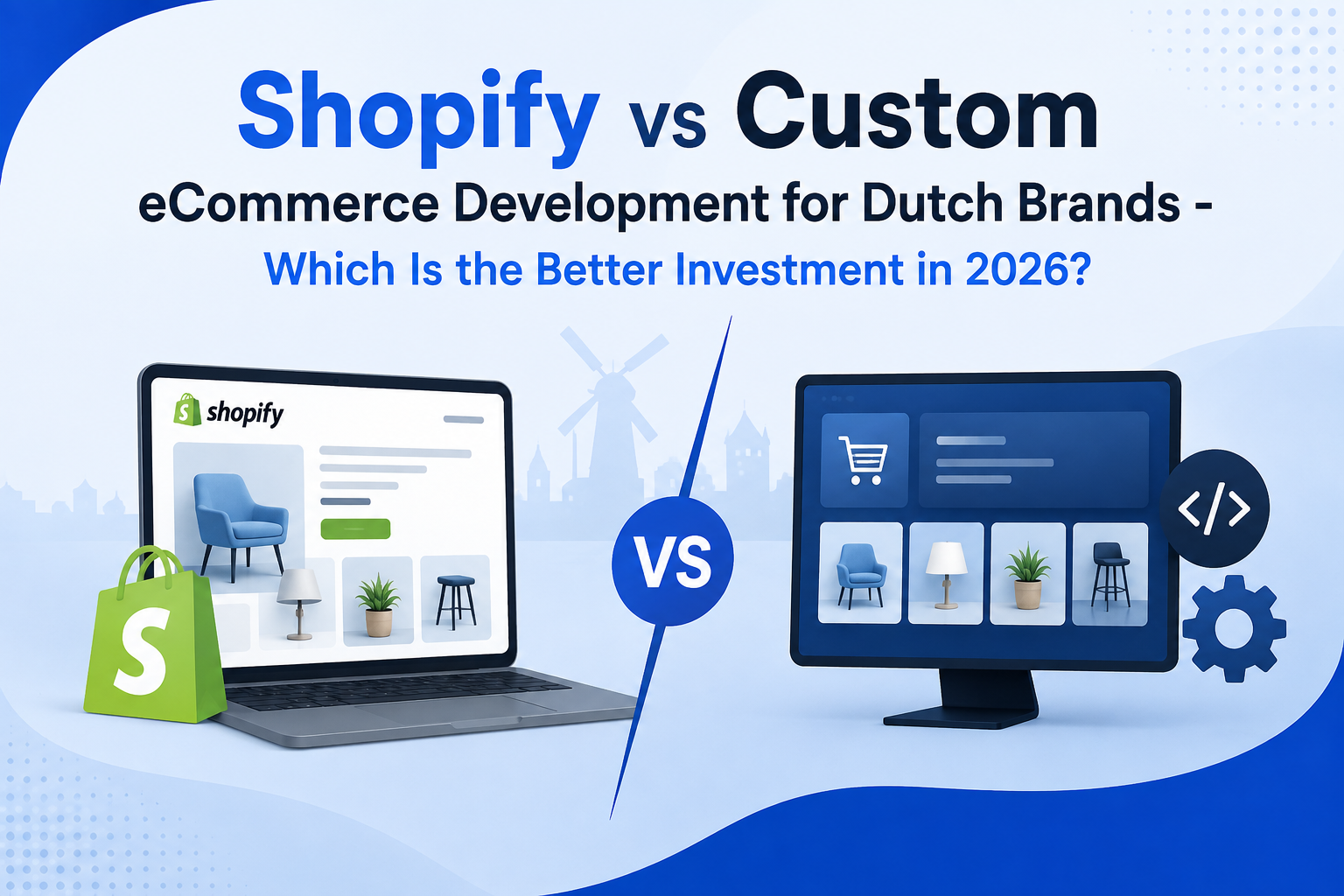
The Dutch eCommerce market continues to evolve rapidly. Consumers now expect more than an attractive online store they demand lightning-fast performance, seamless mobile experiences, secure payments, personalized recommendations, and effortless checkout.
Whether you're an established retailer in Amsterdam, a growing fashion brand in Rotterdam, a B2B wholesaler in Eindhoven, or a startup in Hoofddorp, one decision can significantly influence your online success:
The answer depends on your business goals, growth plans, operational complexity and customer expectations.
While Shopify has become one of the world's most popular eCommerce platforms, it isn't always the right choice for every business. Likewise, custom eCommerce development offers unmatched flexibility but requires a larger investment and a strategic development partner.
In this guide, we'll compare Shopify and custom eCommerce development from a business perspective covering flexibility, SEO, performance, scalability, AI readiness, costs and long-term ROI so you can make an informed decision for your Dutch brand.
According to industry trends, online shopping in the Netherlands continues to grow across sectors such as fashion, electronics, home décor, food, healthcare products, industrial supplies, and B2B wholesale.
As competition increases, businesses need eCommerce platforms that can:
Choosing the wrong platform can lead to higher operating costs, limited functionality, and expensive migrations later.
That's why evaluating your options carefully is essential.
Shopify is a cloud-based eCommerce platform that enables businesses to create, manage, and grow an online store without building everything from scratch.
It includes hosting, security, payment integrations, inventory management, and a wide range of apps that simplify online selling.
Shopify is particularly attractive for businesses looking to launch quickly with minimal technical complexity.
For many startups and small businesses, Shopify offers an efficient way to enter the market.
Businesses can launch a professional online store within weeks rather than months.
Since Shopify provides hosting, infrastructure, and core functionality, upfront development costs are generally lower than fully custom solutions.
Non-technical teams can manage:
without needing programming knowledge.
Shopify handles:
allowing businesses to focus on sales rather than technical management.
Thousands of third-party apps allow businesses to extend functionality for:
Although Shopify works well for many businesses, it's important to understand its limitations before committing.
Every business has unique workflows.
Complex requirements often require custom app development or expensive workarounds.
Examples include:
These can be difficult or costly to implement within Shopify's ecosystem.
While Shopify appears affordable initially, ongoing expenses often include:
Over several years, these recurring costs can become significant.
Many advanced features depend on third-party applications.
Using numerous apps may lead to:
Businesses requiring full ownership over architecture, databases, integrations, or highly customized functionality may find Shopify restrictive compared to custom-built platforms.
Custom eCommerce development involves designing and building an online store specifically for your business, rather than adapting your operations to fit a pre-built platform.
Every feature, workflow, integration and customer experience is tailored to your requirements.
Instead of relying on templates and plugins, a custom solution is built around your business model.
A custom platform can support virtually any business process.
Examples include:
Your business isn't limited by platform restrictions.
Every customer journey can be optimized specifically for your audience.
This includes:
The result is a shopping experience that reflects your brand rather than a generic template.
Growing companies often rely on multiple systems.
A custom eCommerce platform can integrate directly with:
These integrations reduce manual work and improve operational efficiency.
As your business grows, your platform can evolve with it.
Whether you're expanding into:
your platform can be adapted without being constrained by third-party limitations.
|
Feature |
Shopify |
Custom eCommerce |
|
Initial Setup |
Fast |
Moderate to Long |
|
Development Time |
Short |
Depends on Complexity |
|
Customization |
Moderate |
Unlimited |
|
Branding Flexibility |
Good |
Complete |
|
Business Workflow Support |
Limited |
Fully Customized |
|
ERP/CRM Integration |
Possible via Apps/API |
Native & Tailored |
|
Scalability |
Good |
Excellent |
|
AI Integration |
Limited by Apps |
Fully Customizable |
|
Ownership |
Subscription-Based Platform |
Full Ownership |
|
Long-Term Flexibility |
Moderate |
High |
|
Maintenance |
Managed by Shopify |
Managed by Development Partner |
|
Best For |
Startups, SMEs, Simple Stores |
Growing Brands, Enterprises, Complex Businesses |
The right choice depends on more than budget. Consider questions such as:
Yes. Both Shopify and custom-built websites can rank well on search engines. However, the level of SEO control differs significantly.
As Google's algorithms continue to prioritize user experience, technical performance, helpful content, and website quality, having complete control over your site's architecture becomes increasingly valuable.
Shopify includes several built-in SEO features:
For many small to medium-sized stores, these features provide a solid SEO foundation.
As your SEO strategy becomes more advanced, limitations may appear:
These constraints aren't deal-breakers, but they can become noticeable for businesses competing in highly competitive industries.
A custom-built website gives you complete control over every SEO element.
This includes:
Instead of working around platform limitations, developers can build your website around SEO best practices from the start.
Small Stores: Shopify performs well.
Growing Businesses: Custom development offers greater long-term SEO flexibility.
Website speed has become one of the most important ranking and conversion factors.
Visitors expect pages to load almost instantly. Even a short delay can increase bounce rates and reduce sales.
Shopify provides:
Performance is generally consistent, especially when stores use lightweight themes and avoid excessive apps.
However, adding numerous third-party apps can introduce extra scripts that slow down page loading.
With custom development, performance depends on how the website is engineered.
A professionally developed custom store can achieve exceptional speed because unnecessary code, plugins, and features are avoided.
Developers can optimize:
This level of optimization can create a faster, more responsive shopping experience.
When built correctly, custom websites offer greater control over performance optimization.
Excellent user experience encourages visitors to stay longer, explore more products, and complete purchases.
Shopify offers professionally designed themes that provide:
For businesses with standard requirements, this is often sufficient.
Custom development removes design limitations.
Every customer interaction can be tailored to your audience.
Examples include:
Instead of adapting your business to fit a platform, the platform is designed around your customers.
Artificial intelligence is rapidly transforming eCommerce.
Businesses are increasingly using AI to improve customer service, increase sales, and automate operations.
Shopify supports AI through:
These features are effective for many businesses but often depend on external apps.
A custom platform allows businesses to integrate AI directly into their operations.
Examples include:
As AI becomes central to digital commerce, custom development provides significantly greater flexibility.
Many businesses outgrow their original platform.
The question isn't whether your business needs advanced functionality today—it's whether it will need it in the future.
Shopify scales well for:
However, businesses with complex operations often rely on multiple apps, increasing complexity over time.
Custom platforms can evolve alongside your business.
Expansion opportunities include:
There are no platform limitations—only business decisions.
Customer trust depends heavily on website security.
Security includes:
Businesses don't need to manage server security themselves.
Security depends on development quality.
Professional developers implement:
While this requires ongoing maintenance, businesses gain greater control over security architecture.
Both options can provide strong security when implemented correctly.
Businesses operating in the Netherlands must prioritize compliance with the General Data Protection Regulation (GDPR).
Regardless of the platform, your eCommerce store should support:
A development partner familiar with European compliance requirements can help ensure these elements are built into your website from the outset.
The initial development cost is only one part of the overall investment.
Businesses should consider:
While the upfront investment is lower, recurring costs can increase over time as additional functionality is added.
A custom solution generally requires a higher initial investment.
However, many businesses benefit from:
For organizations with complex requirements or long-term growth plans, the total cost of ownership may become more favorable over time.
Choosing the wrong platform often stems from focusing only on short-term needs.
Avoid these common mistakes:
The least expensive option today may result in higher costs later through migrations, additional apps, or operational inefficiencies.
Select a platform that supports your business not only today, but also where you expect to be in three to five years.
A successful online store needs more than attractive design. Strong technical SEO and high-quality content are essential for sustainable visibility.
As your business grows, seamless connections with ERP, CRM, accounting, and logistics systems become increasingly important.
Customers judge your business by how easy it is to browse, compare products, and complete a purchase. Investing in a smooth user experience often leads to higher conversions and stronger customer loyalty.
Answering these questions early can help you avoid costly migrations and ensure your eCommerce platform supports your business as it grows.
Choosing an eCommerce development partner isn't just about hiring developers—it's about finding a team that understands your business objectives, customer expectations, and long-term digital strategy.
At Hesten Solutions Pvt. Ltd., we help businesses build eCommerce platforms that are designed for growth, not just launch.
Whether you're creating a new online store, migrating from another platform, or redesigning an existing website, our focus is on delivering measurable business outcomes through technology, user experience, and data-driven decision-making.
Unlike agencies that simply implement themes or templates, we work closely with clients to understand:
The result is an eCommerce solution that supports sustainable business growth.
Working with an international technology partner doesn't mean sacrificing local accessibility.
Hesten Solutions has an established presence in the Netherlands, allowing businesses to collaborate with a team that understands both global development standards and the needs of the Dutch market.
Hesten Solutions Pvt. Ltd.
Gudumholm 48
2133 HH Hoofddorp
Netherlands
📞 +31 626332035
Having a local point of contact helps simplify communication, planning, and long-term collaboration for businesses across the Netherlands.
Every business has different requirements. That's why we provide flexible solutions instead of one-size-fits-all packages.
Ideal for businesses seeking a reliable platform with faster deployment.
Our Shopify services include:
For businesses requiring complete flexibility and scalability.
Our expertise includes:
Every platform is developed around your business—not around software limitations.
Successful eCommerce projects begin long before development starts.
We identify:
We analyse:
Our designers focus on:
Using modern technologies, we build secure, scalable, and high-performing eCommerce platforms.
Every project undergoes extensive testing, including:
Before launch, we optimize:
After launch, we continue helping businesses improve through:
Clients choose us because we focus on business outcomes rather than just delivering websites.
Our goal is to build digital platforms that continue creating value long after launch.
A Dutch fashion retailer wants to launch quickly with a manageable product catalogue and standard checkout process.
Recommended Solution: Shopify
The business benefits from faster deployment, built-in commerce features, and straightforward day-to-day management.
An industrial supplier needs:
Recommended Solution: Custom eCommerce Development
A tailored platform supports these specialized requirements more effectively than relying on multiple third-party applications.
A company expects significant international growth and wants to introduce AI-powered product recommendations, subscription services, and loyalty programs.
Recommendation: Evaluate long-term business goals carefully. Depending on current requirements and future plans, either Shopify with planned enhancements or a custom platform may be the right fit.
The key is choosing a solution that supports future growth without unnecessary complexity.
No. Shopify is an excellent platform for many businesses, but companies with highly customized workflows, complex B2B requirements, or extensive system integrations may benefit from a custom-built solution.
Custom development typically requires a higher initial investment. However, long-term costs depend on your business model, required functionality, operational efficiencies, and growth strategy.
Yes. Many businesses begin with Shopify and later migrate to a custom solution as their requirements evolve. Planning the migration carefully helps preserve SEO performance and customer data.
Both platforms can perform well when implemented correctly. Custom development provides greater flexibility for advanced SEO strategies, while Shopify offers a strong SEO foundation for many businesses.
Custom development generally offers greater flexibility for implementing advanced AI capabilities, including personalized experiences, intelligent automation, and custom business workflows.
Yes. We provide redesign, performance optimization, SEO improvements, migration services, conversion optimization, and custom feature development for existing online stores.
|
Business Need |
Recommended Option |
|
Launch Quickly |
Shopify |
|
Limited Initial Budget |
Shopify |
|
Standard Online Store |
Shopify |
|
Custom Business Processes |
Custom Development |
|
Advanced B2B Features |
Custom Development |
|
ERP & CRM Integration |
Custom Development |
|
AI-Driven Experiences |
Custom Development |
|
Long-Term Scalability |
Custom Development |
|
Complete Ownership & Flexibility |
Custom Development |
There is no universal "best" platform. The right choice depends on your business goals, operational complexity, and growth ambitions.
The decision between Shopify and custom eCommerce development is not simply about choosing software it is about selecting the foundation that will support your business for years to come.
Shopify offers a fast, reliable, and user-friendly solution for many businesses, especially those looking to enter the market quickly. Custom eCommerce development, on the other hand, provides unmatched flexibility for organizations with specialized requirements, advanced integrations, and long-term scalability goals.
The most successful digital commerce projects begin with a clear understanding of business objectives, customer expectations, and future growth not with technology alone.
Taking the time to evaluate these factors before making a decision can help avoid costly migrations and ensure your eCommerce platform continues to deliver value as your business evolves.
Whether you're considering Shopify, planning a custom eCommerce platform, or looking to redesign an existing online store, Hesten Solutions can help you choose the solution that best fits your goals.
Our experts will provide:
Hesten Solutions Pvt. Ltd.
Netherlands Office
Gudumholm 48,
2133 HH Hoofddorp, Netherlands
Email: vp@hestensolutions.com
Phone: +31 626332035
Let's build an eCommerce platform that not only looks exceptional but also helps your business attract qualified traffic, convert more customers and scale confidently in the Dutch and international markets.
.jpg)